
QUALITATIVE RESEARCH DESIGN: Theoretical Foundations and Empirical Applications
Dr. Muhsyanur, Dr. Lycel Lagnason Pacheco, Dr. Manivannan Murugesan, Dr. Nur Diyana Mustapha, Dr. Kamaruddin Isayah, Dr. Lê Thị Kim Oanh
4/6/20262 min read
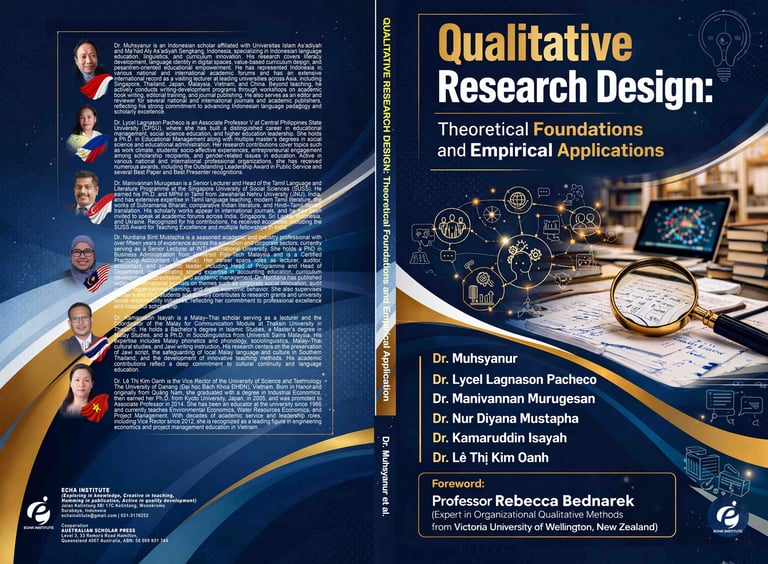
QUALITATIVE RESEARCH DESIGN:
Theoretical Foundations and Empirical Applications
Dr. Muhsyanur
Dr. Lycel Lagnason Pacheco
Dr. Manivannan Murugesan
Dr. Nur Diyana Mustapha
Dr. Kamaruddin Isayah
Dr. Lê Thị Kim Oanh
ISBN:
Thickness: xix + 306 pp., 21 x 15 cm
Editor: Fatemeh Owrang
Layouter: Yayat Siregar
Cover Designer: Pallatto Siregar
Publisher
ECHA INSTITUTE
(Exploring in knowledge, Creative in
teaching, Humming in publication,
Active in quality development)
Jalan Ketintang XB/ 17C Ketintang, Wonokromo
Surabaya, Indonesia
echainstitute@gmail.com | 031-3176252
Cooperation
Australian Scholar Press
Level 3, 33 Remora Road, Hamilton,
Queensland 4007 Australia, ABN: 56 009 931 744
SONOPSYS
Qualitative Research Design: Theoretical Foundations and Empirical Applications is a comprehensive and intellectually rigorous reference volume that addresses one of the most fundamental challenges in contemporary social science research: the gap between understanding qualitative methodology as a collection of technical procedures and understanding it as a coherent intellectual project grounded in philosophical commitments. Spanning fifteen substantive chapters — from the definition and historical development of qualitative inquiry through philosophical foundations, research paradigms, fieldwork design, data collection, coding and analysis, trustworthiness, and the writing of research reports — the book offers the most systematic and accessible treatment currently available of the full spectrum of qualitative research design. Its organizing premise is that methodology and philosophy are inseparable: every decision a researcher makes about how to collect, analyze, and represent qualitative data is the practical expression of ontological, epistemological, and axiological assumptions that must be understood, articulated, and defended if the research is to achieve genuine rigor. Drawing on the foundational contributions of Lincoln and Guba, Denzin and Lincoln, Creswell and Poth, Charmaz, Braun and Clarke, Van Manen, Strauss and Corbin, and scores of other leading methodologists — all cited in full APA format — the book provides both a comprehensive theoretical map of the qualitative landscape and a practical, reflective guide to navigating it at every stage of a research project.
Beyond its comprehensive theoretical scope, what distinguishes this volume from comparable texts in the field is its sustained attention to paradigmatic coherence — the principle that the philosophical assumptions, theoretical framework, research questions, design choices, and quality criteria of a study must form a logically consistent and mutually reinforcing whole — and its integration of forward-looking chapters that situate qualitative inquiry within the rapidly changing landscape of digital, AI-mediated, and globally diversified social research. The book addresses emerging methodological frontiers including digital ethnography, AI-assisted qualitative analysis, arts-based research methods, sensory and mobile ethnography, and the decolonization of research methodology through indigenous standpoints and epistemologies, making it as relevant to cutting-edge contemporary practice as to the enduring foundational questions of the field. Four carefully crafted appendices, a glossary of sixty-seven key methodological terms, and a foreword by Professor Rebecca Bednarek of Victoria University of Wellington complete a volume designed to serve as an indispensable companion across the full trajectory of a researcher's career — from the earliest stages of doctoral training through to advanced scholarly practice — and as a definitive reference for anyone committed to conducting qualitative research with philosophical integrity, methodological rigor, and genuine ethical seriousness.
Cooperation
Jalan Ketintang XB/ 17C Ketintang, Wonokromo, Surabaya, Indonesia
echainstitute@gmail.com
031-3176252
Office
Australian Scholar Press
Level 3, 33 Remora Road, Hamilton,
Queensland 4007 Australia, ABN: +56 009 931 744
NZIE New Zealand Institute of Education
72 Taharoto Road, Takapuna, Auckland 0622, New Zealand
+64 9 489 6205